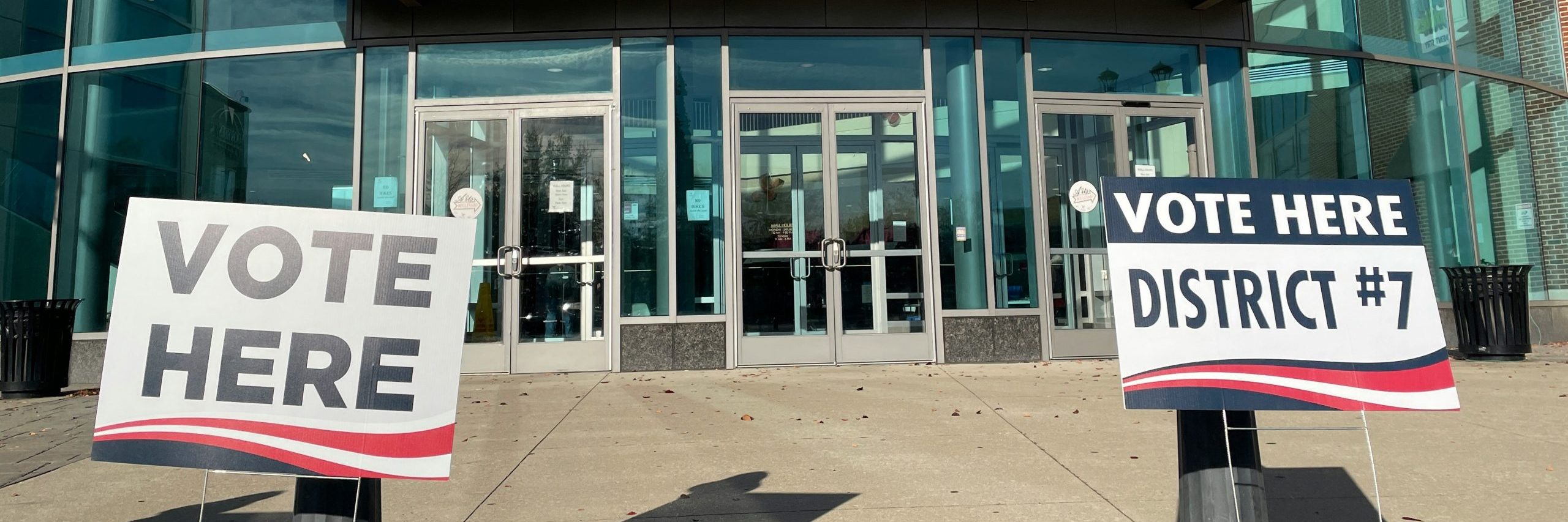
It’s three months until the midterms, and President Donald Trump is once again re-litigating the 2020 election. Judging by his recent prime-time national address, presumably the first of many as he returns to the campaign trail, America’s electoral system could be at risk from widespread noncitizen voting, foreign (particularly Chinese) interference, and cyber vulnerabilities plaguing voting infrastructure.
Trump has prioritized a legislative push to require proof of citizenship for voter registration, which is stalled in the Senate, to the point of refusing to sign a bipartisan law that would lower the costs of homeownership because it didn’t contain his desired provision — putting his own priorities on a collision course with those of his party as it seeks to counter Democrats’ affordability messaging.
His administration’s efforts to compel state officials, charged with managing elections under the U.S. Constitution, to give the federal government greater access to voter rolls have been blocked by the courts. Trump also effectively shuttered an independent commission that helps states run secure elections after unsuccessfully trying to get it to change national voter registration requirements as part of a broader push to bring electoral administration under greater federal control.
Polls show that Trump’s claims of the stolen 2020 election struggle to resonate beyond the president’s MAGA base, with 77% of independents viewing them as mere attempts to sow distrust in election integrity. Still, polls regularly flag “threats to democracy” as the top, or second most important (after the cost of living), issue facing the nation. A majority of voters express concerns about election officials being pressured to change election results (67%), ballots being mishandled or miscounted (57%), or voters facing intimidation as they prepare to cast ballots (52%).
Democrats are especially worried, and data suggests that the administration’s push to change how elections are run could discourage some left-leaning, low-propensity voters from turning out. At the same time, polling data and behavioral evidence from the 2022 midterm cycle — the first national election that followed the Jan. 6, 2021, storming of the U.S. Capitol — indicate that election integrity concerns did deliver marginal gains to Democrats, particularly against Republican candidates that denied Trump’s 2020 loss. The trend continued in 2024, when election deniers underperformed both in the primary and general elections.
Democratic Party leaders are preparing for scenarios where they think the administration might try to disrupt the vote, including swing-state voter roll purges, AI-generated disinformation, and the U.S. National Guard or federal law enforcement personnel deployed to polling places on Election Day. White House officials have so far declined to rule out any such actions, but state-level Republican election officials dispute many of Trump’s claims. Ironically, it’s Democrats’ own lapses, like a glitch in New Jersey’s voting equipment that enabled some noncitizens to cast ballots, that could give unintentional credence to Trump’s election fraud allegations.
Much has been written about how smaller, niche voter groups like infrequent voters or “double haters” (those holding a negative view of both major parties or presidential candidates) shifted right in 2024, helping put Donald Trump over the edge in his close race against Kamala Harris. We decided to dig deeper into the available data to see how these groups are leaning, assuming they make it to the polls in November.
An analysis of 2024 voter data suggests that cycle’s irregular voters (those who skipped 2020 or other recent general elections) were more likely to be Latino, younger people, urban residents, or less-partisan voters without a college degree — the very groups that have been moving away from Republicans as their dissatisfaction with Trump’s economic policies grows. (To be sure, this group is even less likely to vote in midterms than presidential elections, so they may stay home regardless of their political leanings.)
With double haters, the picture is more complex. Trump won this group by double digits in 2024, 2020, and 2016, according to exit polls. In the 2022 midterms, they favored Republicans, who won control of the House; in the 2018 midterms, which Democrats won, they split their vote equally between the two parties.
Interestingly, when asked in April 2024 how they planned to vote in that year’s presidential election, double haters favored Joe Biden by 10 points before the former president’s favorability took a nosedive following his debate loss to Trump; eventually, they chose Trump over Harris by 20 points. This cycle, double haters are favoring Democrats by 26 points, 55% to 29%, which is close to their 32-point preference for Biden ahead of the 2020 election — when they instead ended up voting for Trump by 18 points.
While comparison between groups that dislike both major parties and both presidential candidates from those parties is an imperfect one, we’re taking double-hater polling data with a grain of salt. Some of these voters may be weaker partisans who might return to their political home as the midterms approach.
One point where irregular voters’ presumed shift to the left and double haters’ apparent inclination toward Democrats converge is the intense dissatisfaction with the political status quo that cuts across virtually all voter demographics. In fact, the farther voters tilt to the left, the more likely they are to want “dramatic” or “revolutionary” change, from 60% of Democrats aligned with the Democratic Socialists of America to 26% of MAGA Republicans.
In the meantime, even reliable Republican voters are losing enthusiasm for the midterms over cost-of-living concerns, including high gasoline prices — significant, given that in 2022, people who thought gas prices were a hardship turned out against the party in power (then, Democrats) by 29 points. Republican efforts to vilify Democrats as far-left extremists could backfire with the electorate that’s more likely to back an openly socialist candidate than one endorsed by Trump or aligned with MAGA.
If at least some of these former Trump supporters vote Democrat, that could make a difference in close races. Ultimately, though, turning out low-propensity, politically disengaged voters is a marathon rather than a sprint, considering that people making voting decisions late in the campaign, as these groups tend to be, tilted Republican in 2024, 2022, 2020, and 2016 — but not in 2018, when they swung left as part of that year’s blue wave.
Ever since the start of the war in Iran, prominent figures in the MAGA movement have argued that launching an open-ended military operation in the Middle East, with regime change as part of an initial set of objectives (later downplayed in favor of terminating Iran’s nuclear program), is contrary to the ethos of “America First” and President Trump’s campaign pledge of “no forever wars.”
So far, this debate has been playing out on the Republican Party’s hard-right and libertarian fringes without filtering into the mainstream campaign rhetoric, which largely treats “America First” as Trump’s umbrella brand and portrays the Iran war as a prime example of his “peace through strength” foreign policy agenda. Trump himself famously said “America First” means whatever he thinks it does, and preventing Iran from acquiring a nuclear weapon is as “America First” as can be.
Nevertheless, the definition of “America First” is far from settled — and may be expanding beyond Trump’s control. For Vice President JD Vance, an Iraq war veteran and one-time member of MAGA’s isolationist wing, it has evolved from explicit disavowal of endless foreign wars to a nuanced vision for a Trump Doctrine that allows for limited military engagement if it clearly meets American interest. Laura Loomer, a conservative influencer with close ties to Trump, recently declared support for Ukraine to be “America First” after years of propagating pro-Russian views.
Some Democrats, mainly progressives, are putting their own stamp on “America First” that echoes Trump’s original focus on domestic priorities above all else. We’ll be watching the upcoming Democratic Senate primary in Michigan to see how well the idea resonates with swing-state Democratic voters.
Since late May — around the time the U.S. and Iran took first steps toward a ceasefire framework that had reopened, albeit temporarily, the Strait of Hormuz — President Donald Trump’s job approval has been on the upswing.
From -20 percentage points around May 20th (a historic low for Trump, although a far cry from President George W. Bush’s -46 in the midst of the 2008 recession), Trump’s average net approval has inched up to -17, buoyed by the lull in fighting, hopeful rhetoric, and a 9.7% decline in gasoline prices that contributed to a larger-than-expected drop in the U.S. inflation rate.
Republicans’ standing on the generic congressional ballot, a measure of voters’ preference for a party to represent them in the U.S. House, has strengthened in parallel, reducing Democrats’ advantage from around 7 points at the end of May to 6 points today.
But now that the ceasefire is over and the Strait of Hormuz blockade on Iranian vessels has been restored, the future trajectory of Trump’s job approval, and the downward pressure unpopular presidents tend to exert on their party in the midterms, will depend on public perceptions of the cost of living in the Trump economy, the single most important factor 45% of voters say will determine their choices at the ballot box.
Nearly five months in, the war in Iran remains unpopular. A majority of Americans, 57%, oppose it, and 60% believe U.S. military actions in Iran haven’t been worth it, a 10-point increase since April. Fifty-three percent, including 62% of independents, say the U.S. made the wrong decision initiating the military operation in the first place.
Self-identified MAGA Republicans are the only group that consistently backs Trump’s foreign policy agenda, but even they are now less likely to say the war has been the right decision (net -6 points since April) or has been worth it (net -10 points) — an indication that doubts about Trump’s decision-making on Iran cut across party lines. Skepticism of the Trump administration’s Iran diplomacy has been widespread across the board, with half of MAGA voters and 71% of voters overall concerned that peace talks would fail; last week, the doubters have been proven right.
Before the ceasefire, support for the war among congressional Republicans has been eroding. So far, House Republican leaders remain largely silent about the renewed hostilities as they pursue an additional $73 billion in defense and intelligence funding. In the Senate, Republicans are showing more visible dissent, although most still support the administration, while Democrats are turning a typically bipartisan annual defense policy bill, which calls for a 28% boost in national defense spending, into a political battleground. More relevant to an average voter, gas prices are rising again — an everyday cost of the war that resonates across the political spectrum.
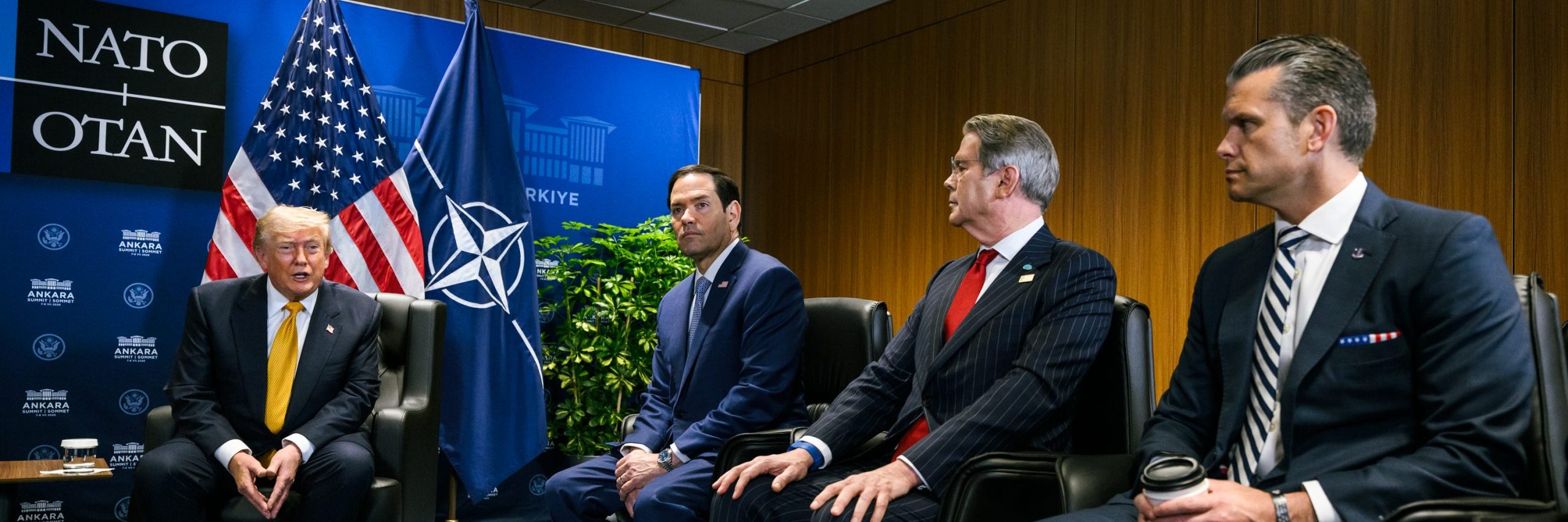
President Trump’s trip to last week’s NATO summit in Ankara has shed no new light on the durability of his administration’s commitment to the bloc or America’s role in European security going forward. Publicly, Trump remains critical of NATO allies’ lack of support for the U.S. war with Iran, disdainful of most European leaders (with a possible exception of NATO Secretary General Mark Rutte and Ukrainian President Volodymyr Zelensky), and openly transactional on a broad range of issues, including allied defense spending, control over Greenland, and military assistance to Ukraine.
Some of Trump’s more radical policy proposals aimed at scaling down U.S. involvement in NATO, such as complete withdrawal from the alliance or a drastic reduction in troop deployments across Europe, would require an act of Congress, where they currently face bipartisan opposition. Instead, Trump has been using national and sectoral tariffs, trade investigations (most recently against Germany over drug pricing), and other coercive trade tools to erode confidence in the predictability of U.S. involvement and accelerate Europe’s shift toward greater defense autonomy.
Domestically, America’s role in NATO is a highly partisan issue if not one likely to drive midterm voting decisions for most people. Eighty-two percent of Democrats believe the U.S. benefits from being a member, while just 38% of Republicans agree, down from 55% at the end of Trump’s first term.
MAGA Republicans are ambivalent, with 63% saying the U.S. should withdraw from the bloc yet 69% still willing to defend an attacked ally and around two-thirds viewing NATO as useful for deterring Russian aggression, securing the Arctic, and strengthening America’s defense industrial base. Three-quarters of MAGA supporters think NATO is obligated to help the U.S. in Iran, while just 36% of all voters concur — a smaller gap in perceptions than on Trump’s foreign policy as a whole, which has backing of 90% of MAGA voters and 38% of voters overall.
Even as support for both the Iran war and Trump’s broader foreign policy declines — net approval of the latter is down 18 points since the start of his second term, and Republicans’ credibility on national security is down roughly 7 points — Democrats in Congress have made no corresponding gains, meaning that dissatisfaction with Trump’s approach has not yet translated into greater confidence in Democrats’ ability to manage foreign policy. The open question is whether the party can fold the unpopular war, and its impact on gasoline prices, inflation, and federal spending, into their broader cost-of-living argument, using foreign policy to reinforce rather than distract from their strongest domestic message.
Eight years ago, Democrats turned Republican efforts to repeal the landmark Obama-era health care law into a top campaign issue, helping them win control of the House in the party’s biggest midterm gain since 1974. This cycle, they are adapting their 2018 playbook to align with an overarching affordability message, using the Trump administration’s cuts to federal health insurance programs — which have already raised costs for many and are set to reduce access for lower-income Americans in the coming years — as an opportunity to reach swing voters in competitive races.
Their approach fits the moment: nearly two-thirds of U.S. adults, 64%, worry about being able to afford health care, the biggest financial concern that retains its top spot despite growing anxiety about gas and transportation costs (at 64%, up from 52% in January). Health care is also the cost voters most want Congress to address (at 28% compared with 15% for the cost of gasoline), and the issue a majority, including 63% of independents, say will have a big impact on the way they vote in the midterms.
Democrats have a clear advantage on health care costs, with 45% of voters trusting them more to manage the issue compared with 28% who trust President Trump and Republicans. There is a general sense that the party is more attuned to health care-related concerns than Republicans in Congress, who are focused on partisan priorities like immigration or foreign conflicts.
Trump’s approach to health care costs is unpopular: just 33% of voters approve, including 25% of independents and 36% of non-MAGA Republicans — indicating a possible opening for Democrats’ cost-based arguments among weak Trump supporters. Republicans do have an edge on their perceived ability to root out fraud and abuse in government health programs — where 34% of voters trust them compared with 24% that trust Democrats — but the administration’s handling of health program fraud still meets with majority disapproval, at 58%.
Both parties are already deploying health care-related messaging in midterm battlegrounds, with Democrats targeting states and districts impacted by the cuts to federal health insurance while Republicans portray those cuts as a way to curb waste and focus on market reforms to lower costs. The result is a midterm fight in which health care is less a replay of 2018 than a test of whether Republican-controlled Washington can be made politically accountable for costs voters already feel and cuts whose effects are still unfolding.

What does it mean to be a Democrat at a time when Americans are polarized politically yet increasingly avoid identifying with a major party? Four months ahead of the midterms, Democrats are still searching for a unified set of principles and policies that could resonate beyond their base to rally independents, non-MAGA Republicans, and politically disengaged voters who supported Donald Trump in 2024 but are now experiencing a case of buyer’s remorse.
This year’s Democratic primaries are giving unusually high visibility to progressive, anti-establishment, and populist candidates, some of whom identify with the Democratic Socialists of America, the political home of Sen. Bernie Sanders and New York City Mayor Zohran Mamdani.
Unlike in 2018, when an anti-Trump backlash elevated a group of high-profile progressives as part of the biggest Democratic wave in nearly half a century, today’s crop of challengers is as much a product of broad anti-Trump mobilization as it is a reflection of profound intra-party divisions over affordability, Israel, corporate power, and whether the party’s inherited governing model is adequate to the scale of the problems facing the nation.
Establishment Democrats are concerned that far-left populists could founder in general elections where the electorate is less partisan than in the primary. But among Democratic-leaning voters, 88% view America’s economic system as unfair, and 83% think it either needs to be torn down entirely or undergo major changes.
Fifty-three percent are dissatisfied with the Democratic Party, and 58% believe the current crop of Democrats in office isn’t doing enough to fight back against the Trump agenda. Two-thirds would rather vote for a candidate who promises to lower prices by going after corporate price gouging than one who would make it easier to build housing and expand energy production — favoring a populist affordability argument over the center-left abundance case.
Factor in Democrats’ improving perceptions of socialism (66% positive, up from 57% in 2018) and willingness to back their party’s candidates regardless of personal baggage, just to prevent Republicans from winning, and this year’s anti-establishment mood on the left could be more consequential than eight years ago.
As Republicans grapple with President Trump’s unpopularity, Democrats are expanding their advantage on a measure of voters’ preference for a party to represent them in Congress, which currently stands around 6 percentage points, roughly where it was at a similar moment in 2018. They are 7 points ahead on their perceived ability to manage the cost of living, this year’s most salient issue, and 11 points ahead on voter enthusiasm, turning out to vote in this cycle’s primary and special elections at an exceptionally high rate.
Republicans’ lack of a cohesive affordability platform provides an opening for populist Democrats, especially if they can tie cost-of-living pressures to corporate power, housing, health care, and wages in a way that feels concrete rather than ideological. In the meantime, Trump’s rhetoric portraying Democratic socialist candidates as far-left extremists puts an already battered Democratic brand (-20 points favorability on average, compared with Republicans’ -17) under additional pressure, and the party’s ability to rebut these attacks could make or break its chances with late-deciding swing voters in close races.
With President Trump’s net job approval at -17 points, Republicans’ ability to defend their majorities in the U.S. House and Senate hinges on keeping the many disparate elements of Trump’s 2024 winning coalition on board. One of those is Make America Healthy Again (MAHA), a loose public health movement rooted in “crunchy” liberal environmental politics, whose food-related priorities — including concerns about ultra-processed foods, additives, and pesticides — have a clear cross-partisan appeal.
Just under a third of U.S. adults identify with MAHA, including half of Trump’s 2024 voters and 20% of those who supported Kamala Harris for president. But its goals related to cleaning up American diets are overwhelmingly popular across the board and are one of relatively few areas of bipartisan collaboration in Congress and state legislatures.
After a strong start that positioned Health Secretary Robert F. Kennedy Jr., a MAHA figurehead (and former Democrat), as one of the most visible members of Trump’s cabinet, the movement is at a crossroads, increasingly divided over the administration’s moves to reduce childhood vaccinations (MAHA’s most controversial priority), protect pesticide manufacturers from lawsuits, and cater to food and agriculture interests over a grassroots agenda championed by “MAHA mom” influencers and activists.
Still, the White House views Kennedy as a valuable midterm asset and has recently dispatched him to several swing congressional districts where he appeared alongside Republican candidates, often with no known MAHA ties. Some of Kennedy-aligned political groups have made endorsements in Republican primaries, but their publicly confirmed spending has so far been limited to two high-profile contests, in one of which a MAHA-endorsed populist prevailed over a MAGA candidate backed by Trump.
Looking ahead to the general election, MAHA supporters — roughly 40% of whom are reluctant to vote for Republican candidates based on the administration’s record to date — could make a difference in close races, whether by staying home or (less likely) backing a Democrat. Meanwhile, some Democrats with records on food safety, chemical regulation, and sustainable agriculture are courting MAHA-curious voters, hoping to unravel the already fragile MAHA-MAGA alliance.
For the second election in a row, Republicans are leading the way on using AI for a growing number of campaign tasks like conducting simulated polls, creating and testing ads, fundraising, and voter outreach. So far this cycle, some of the most sophisticated, and controversial, AI-generated content has come from Republican primaries, MAGA-aligned candidates, and pro-Trump or right-leaning groups.
Republican primary races in Texas (Senate) and Kentucky (House) offer the clearest examples of deepfake-style AI attacks being used as part of intra-party escalation to help propel a MAGA candidate to victory, although other factors, like a Trump endorsement, also played a role. The Trump White House and administration officials like Health Secretary Kennedy frequently use AI-generated imagery in official communications, effectively normalizing deepfake-adjacent content for Republican-aligned voters — while further eroding trust in government and political information across the board.
On the left, some progressive Democrats are beginning to experiment with AI-generated content in primaries, especially against centrist or establishment-aligned rivals, but their use has been more cautious and they have not yet embraced deepfakes as a category.
Studies show that voters can find deepfakes persuasive, even when they know or suspect that content is false, and voice clones can be particularly hard to detect. Americans appear to be on guard, with 85% viewing AI as a likely vector for spreading election disinformation.
A majority of voters, 60%, feel confident they can tell if something is AI-generated, but that number is 46% for older adults, who are more likely to vote in midterm elections. There is some indication that a deepfake ad may have helped tip the scales for some older voters in the Kentucky District 4 primary despite the fact that it included an AI disclaimer, which is required in 27 states. (By contrast, a deepfake targeting Zohran Mamdani in the 2025 New York mayoral election generated backlash and contributed to his rival’s collapse among younger voters.)
Between now and November, we will be watching whether Democratic campaigns begin using deepfake-style content — and whether AI-generated media is deployed specifically to amplify election-integrity doubts, already more present among Republicans and independents, or manipulate turnout in close races.

Two years ago, Donald Trump’s grip on the Republican Party appeared nearly absolute: Republican elites remained loyal to him despite multiple criminal indictments, and regular voters largely rejected Nikki Haley’s more conventional brand of social conservatism. Since then, President Trump has been systematically rooting out dissenters from within the party’s structures, using endorsements, primary threats, and public attacks to reward loyalists and punish those who cross him.
These tactics are a key factor behind the historically large number of Republican departures from Congress at the end of this term (43 compared with 37 in 2018) — and they have an unintended consequence of amplifying pushback from those lawmakers who have little to lose. In recent weeks, enough Senate Republicans, both those headed for retirement and those facing competitive reelection races, sided with Democrats to defund projects personally important to Trump, like a $1.8 billion fund to compensate his allies for alleged government targeting. In the House, enough Republicans helped push Democrat-led efforts to end U.S. war with Iran and send new military aid to Ukraine over the finish line.
Some of these actions, like voting to end the Iran war that Congress never approved in the first place, are purely symbolic. But they illustrate a growing tension between the White House and Republican candidates forced to sell Trump’s expansive domestic and global agenda to an electorate concerned with the cost of living above all else. This preoccupation is evident even among the president’s MAGA base, where his job approval is down 5 percentage points since just before the start of the war with Iran, to 92%, while support for the way he is handling inflation is down 14 points, to 66%. (This compares to a 7-point decline in his approval among all voters, to 24% from 31% in February.) To MAGA voters, inflation is now the top issue driving their choices at the ballot box, at 28%, bypassing immigration at 15% and reversing the pre-war dynamic where these voters prioritized immigration over inflation, 24% to 22%.
Another outcome of Trump’s efforts to purge dissent from his party’s elected ranks may be a weaker crop of candidates facing Democrats in November. Since the start of his second term, Trump-endorsed Republicans lost two-thirds of general and special elections, weighted down by the president’s historic unpopularity and relatively low approval of his administration’s biggest achievements (including last year’s tax cuts that Americans believe largely benefit the wealthy). Voters in swing congressional districts increasingly blame Republicans in Congress for making life less affordable, but view neither party as a clear leader on fighting inflation.
Nationwide, Democrats are roughly 7 points ahead on a measure of voters’ preference for a party to represent them in Congress, but they are yet to coalesce around a single, party-wide plan to address the cost of living. Time is running short for them to meld a growing menu of affordability proposals into a unified agenda before November. But in the meantime, Trump’s assurances that prices are coming down, or will soon, are leaving little space for his party to show that they are doing something concrete to cut costs.
Trump Weighs New Duties to Rebuild His Tariff Wall
Companies are beginning to claim the money they paid under President Trump’s “reciprocal” tariff program, with more than $23 billion already refunded out of the $166 billion collected since April 2025. But the Trump administration is appealing the trade court ruling that authorized the refunds, seeking to limit the payouts either to companies that were part of the Supreme Court case that invalidated the tariffs, those that have refunds underway, or those actively challenging the government’s refusal to refund them. If successful, the appeal would exclude those businesses that did not particulate in the original case and whose transactions were finalized months ago. The litigation is unlikely to halt refunds already moving through the system, but it amplifies uncertainty for those importers that may now be required to file their own lawsuits to reclaim what they are owed in full.
In the meantime, in an effort to recapture some of the lost revenue, the administration is considering new Section 301 tariffs against 54 countries in response to their alleged failure to block imports produced with forced labor. Sixteen countries, including the EU, Canada, and Mexico, could see an additional duty of 10% on top of other tariffs already in place, while the remainder, including China and Switzerland, could be taxed an extra 12.5%. Some categories of imports, including food, fuels, critical minerals, and USMCA-compliant goods from Mexico and Canada, would be exempt, as would be goods already taxed under Section 232, like autos, parts, steel, and aluminum.
The earliest these tariffs could go into effect is July, creating a possibility of a seamless — at least theoretically — transition away from temporary 10% tariffs under Section 122, which expire July 24. Both tariffs are similar as to which categories of goods they exclude, and Section 301 duties tend to be relatively immune to legal challenges.
We are also watching a separate Section 301 investigation into alleged excess industrial capacity in 16 economies, including the EU, China, Mexico, and Switzerland, the results of which are expected soon. It is an open question whether any duties that follow from that probe would stack on top of those proposed under the forced labor investigation. But if both tariffs were finalized, the administration could use them together to replicate much of the practical coverage of the Section 122 tariffs, albeit through a more durable legal architecture.
What We’re Watching: U.S.-China Board of Trade
Details are emerging about the proposed U.S.-China Board of Trade, one of the main takeaways from the otherwise uneventful May summit between President Trump and Chinese leader Xi Jinping. The board is expected to cover about $30 billion worth of non-sensitive goods on each side, which could qualify for reduced tariffs — possibly as low as the “most favored nation” average rate of 3% that prevailed until Trump’s first wave of China tariffs in 2019.
The administration is soliciting comments from industry and other interested parties on which categories of Chinese goods should be included without creating economic, national security, and supply chain resilience risks. Publicly announced discussions surrounding the proposed bilateral mechanism point to agriculture, aviation, and certain supply-chain inputs like critical minerals. The latter, as well as the specific mention of goods subject to tariff inversion between manufacturing inputs and final products (when the duty on finished goods is lower than the duty on the inputs used to make them), could matter to auto-parts and other industrial supply chains that include autos.
The Board of Trade, expected to function in tandem with a Board of Investment intended to evaluate Chinese investments into non-strategic U.S. industries, appears to be the most tangible feature of the new strategic stability framework that is supposed to define the bilateral relationship from now on, or at least through the rest of the Trump term. The administration’s main goal is to keep the relationship in balance through November, considering that a trade “truce” that temporarily reduced tariffs on both sides expires just days after the midterms and has not yet been extended.
An uninterrupted flow of rare earths and critical minerals to U.S. companies and allies like Japan remains a concern, as does China’s potential response to the proposed new Section 301 tariffs described above and to various efforts to tighten export controls on advanced AI chips that are being pursued through regulation and as part of trade talks with Taiwan. Chinese retaliation on rare earths, semiconductors, or agricultural purchases could give the administration grounds to reinstate higher tariffs on Chinese goods, adding a layer of economic uncertainty. As the Board of Trade takes shape over the summer, with public comments due in July, we will be watching for the administration to frame it as a high-profile deliverable ahead of Xi’s proposed visit to Washington this fall.

Six months ahead of the midterm elections, President Donald Trump’s job approval, the clearest predictor of the ruling party’s performance at the ballot box, seems settled below 40%. This is roughly 2 to 5 points lower than at the comparable point in 2018, Trump’s first midterm cycle, when Republicans lost a net total of 40 seats in the House.
None of the developments that typically produce a rally effect around a president — tax cuts targeted at workers and retirees, populist moves like prescription drug price controls, a foreign conflict framed as a national security imperative, or the latest assassination attempt — have resonated outside Trump’s own coalition.
Among voters who shifted his way in 2024, attrition is real, particularly among independents, Latinos, and younger people. At the same time, the president’s MAGA base remains cohesive and capable of delivering results, most recently securing a slate of primary wins in Indiana against state lawmakers who had opposed Trump’s push to redraw the state’s congressional boundaries to boost his party’s standing in the midterms.
Even though Trump’s endorsement remains highly significant and often decisive in Republican primaries, his favored candidates have performed worse against Democrats across primary and general elections in 2025 than in any year since 2017, winning 33% of the races. To be sure, voters in primary and special elections tend to be more politically engaged and motivated. But Democrats are also showing a broader advantage in midterm enthusiasm, with 79% saying they are “absolutely certain to vote,” slightly higher than MAGA Republicans, at 77%, and far higher than right-leaning voters not aligned with MAGA, at 59%.
The Democratic Party also benefits from improved trust in its ability to handle this cycle’s top electoral issues, polling 4 percentage points ahead of Republicans on the economy, 52% to 48%, and 8 points ahead on inflation, 54% to 46%. Trump’s own approval on these issues is historically low, at 34% and 28%, as more Americans say they are falling behind financially since the start of the war in Iran, at 23% compared with 17% in Feb. 2026.
Trump’s war in Iran is now as unpopular as the Iraq War in 2006, during peak violence, and the Vietnam War in the early 1970s, with 61% of U.S. adults calling it a mistake. Time will tell if Trump’s claims that the situation is under control translate into an actual peace deal. Regardless, it may take months for gasoline prices to come down to prewar levels — possibly too late to buoy Republicans’ chances in a cycle where the cost of living remains paramount.
A month ago, Virginia voters approved a new, Democrat-friendly congressional map to be used in this year’s midterms. Last week, the Supreme Court told Louisiana to redraw the lines of a majority-Black House district, setting a precedent for other Republican-leaning states across the South.
The ruling, which weakened a landmark 1965 law that prevented racial discrimination at the ballot box, is set to usher in a wave of congressional redistricting leading to the 2028 presidential election, as Republicans and Democrats vie for advantage in an increasingly calcified electoral landscape with a shrinking number of competitive House seats.
This cycle, though, Republican options are limited by state-level legislative calendars and concerns that aggressive gerrymandering could backfire by spreading right-leaning voters too thinly over resulting districts. Besides Louisiana, already at work on a new congressional map, we are watching Tennessee, Alabama, and South Carolina. All in all, the court decision could create as many as four new House seats that favor Republicans this cycle alone — and that does not include Florida, which just approved a new congressional map that could create another two to four Republican-friendly seats.
The court ruling and the new Florida map could finally put Republicans ahead in a race that began with a push to redraw congressional maps in Texas, Missouri, North Carolina, and Ohio. It was followed by Democratic countermoves in California, Utah, and Virginia that largely cancelled out Republican gains.
On the one hand, a rightward shift of just a few seats could be significant, considering that the past three House elections all delivered single-digit majorities. On the other, Republicans, already likely to lose seats as the party in power, are facing rough political terrain shaped by Trump’s unpopularity and the rising cost of living, for which the Republican-held Congress has struggled to offer coherent policy remedies.
Today, they are trailing Democrats by 6 points on a measure of voters’ preference for a party to represent them in Congress, close to the 7-point deficit they had at a similar point in the 2018 race. But while Democrats outperformed in nearly every election since Trump’s return to office, their House vote share, 49%, still lags the president’s 62% disapproval rating, with many disaffected right-leaning voters inclined to stay home rather than vote Democrat.
President Trump played gracious host to a UK royal visit last week, even lifting some tariffs on Scotch whisky to toast the departing King Charles III and Queen Camilla. He has been far less gracious to other European leaders over their reluctance to support U.S. military action in Iran.
Trump, for example, suggested that German Chancellor Friedrich Merz focus on “fixing his broken Country” and step up his “ineffective” efforts to end the war in Ukraine. He followed up by announcing a 25% tariff on EU cars and trucks, most of them carrying German nameplates, citing noncompliance with a 2025 trade agreement and suggesting that higher levies could help push European car companies to move production stateside. He also authorized the withdrawal of up to 5,000 American troops from German military bases.
Taken together, the president’s rhetoric and actions fit the pattern, carried over from his first term in office, of singling out Germany as an object of pressure within Europe as a result of its combination of three factors that irritate him: a large trade surplus with the U.S., globally visible automakers, and a major U.S./NATO military footprint.
Following a “great call” with European Commission President Ursula von der Leyen, Trump set a July 4 deadline to implement the EU trade deal, taking the 25% tariff on EU autos off the table, at least for the time being. But the Germany troop drawdown is official and backed by precedent: Trump had tried to withdraw 12,000 troops from Germany in 2020, only to be overruled by President Biden, and has recently pulled out a thousand troops from Romania. Also, unlike the auto tariff, opposition to the drawdown is bipartisan, with top Republicans in Congress advocating for moving the troops to Eastern Europe to better deter Russia while Democrats accuse Trump of taking Russia’s side in the Ukraine conflict.
Even 5,000 personnel short, the U.S. military footprint in Germany would remain at roughly 31,000 and in Europe overall at around 80,000, above the 76,000 threshold set by Congress. It is unclear, however, if any U.S. law — including the 2026 defense policy law Trump himself signed, which sets a list of hurdles before enabling major changes to U.S. European Command — would stop the president from penalizing NATO allies for failing to help secure the Strait of Hormuz.
The next few weeks will give us a better idea whether Trump’s latest swipe at Berlin is indeed about Berlin, or autos, or about a broader U.S. military shift away from Europe and toward the Indo-Pacific, just as key Trump advisers like Elbridge Colby have long advocated.

As the dust settles following President Donald Trump’s announcement of a two-week Iran ceasefire, questions remain about how the six-week military operation’s aftermath could impact Republicans’ chances in the approaching midterm elections and with them, the rest of Trump’s second-term policy agenda.
Since the start of the war, Trump’s job approval, historically the clearest predictor of the ruling party’s midterm performance, has dipped below 40% (16 percentage points underwater, according to a polling average), trailing any recent predecessor at a similar point in his tenure. Still, Trump’s standing with his core supporters — self-identified MAGA Republicans and a somewhat broader coalition of his 2024 voters — has barely budged, suggesting that his vision of “America First” as proactive, high-stakes interventionism on a global scale is largely in synch with their own despite vocal pushback from prominent right-wing media figures.
One metric that has begun to shift is the Trump electorate’s approval of the way he is managing the war. It is down roughly 10 points since early March, coupled with a steady decline in the share of his voters who “strongly” support his handling of the conflict, according to a series of Economist/YouGov weekly polls — suggesting a degree of unease, even among his most fervent backers, with his incendiary rhetoric and scorched-earth tactics.
If the Iran ceasefire holds, enabling safe passage through the Strait of Hormuz, we may see some shifts within the peripheral segments of the Trump 2024 universe — among non-MAGA Republicans (roughly a quarter of all Republican voters) and independents who helped swing the election Trump’s way in four out of seven battleground states. Among both groups, support for the war and the president’s job approval has plummeted. However, any rally-around-the-flag effect is likely to be minor, considering a significant gap in intensity between those who “strongly oppose” and those who “strongly support” Trump’s actions in Iran and his policies more generally. Even before the first U.S. missiles were fired at Iranian targets, the consistent decline in public support of Trump 2.0 has been driven primarily by his cratering net approval on kitchen-table issues, such as the economy (-22 points), trade (-24 points), and inflation (-34 points).
Trump himself will not be on the midterm ballot, but his weak polling numbers could impact down-ballot races, pushing swing voters to the left and keeping politically disengaged ones home, especially if prices of gasoline and other staples stay high. Democrats remain unpopular but they hold a 6-point edge on voters’ preference for the party to represent them in Congress and a 31-point lead among those with a negative view of both parties, another group that broke in Trump’s favor in 2024. Earlier this week, a Democrat performed stronger than expected in a special House election in Georgia, adding to a series of swings toward Democrats in conservative districts and putting on notice the 20 or so House Republicans who won in 2024 by 10 points or less. Barring a quick, durable Iran peace deal, which few outside the MAGA inner core think possible, Democrats could do well to use any lingering war-related drag on prices and supply chains to keep their base engaged and energized in the weeks ahead.
A year ago, in early April, President Trump used the International Emergency Economic Powers Act (IEEPA) to impose blanket duties on much of America’s imports, driving the effective tariff rate (the share of total U.S. imports collected in duties) from 2% to roughly 21%, the highest in a century. Weeks ago, a Supreme Court ruling overturned the so-called Liberation Day tariffs, pushing that rate down to 11% and leaving the administration with a patchwork of industry- and product-specific duties tied to national security concerns under Section 232 and unfair trade practices under Section 301. Other sectors and product categories remain exempt, while goods from countries that have reached trade deals with the administration face lower rates, often in exchange for commitments to shift production to the U.S. All in all, the administration has revised tariff policy at least 50 times (most recently adjusting duties on steel, aluminum, and copper), with further changes likely when a 10% Section 122 tariff covering many goods previously taxed under IEEPA expires in July.
The White House argues that the tariffs have stimulated domestic investment and won valuable concessions from America’s trading partners. In practice, the results are mixed. Some manufacturers have managed to blunt the impact by reconfiguring supply chains and expanding U.S. operations, but they have done so amid declining payrolls and slower new factory construction. For consumers, the cost of living continues to rise, adding to growing disenchantment with Trump’s economic policies even among his base. Since January, Trump’s economic approval rating has fallen 14 percentage points among Republicans, compared with an 8-point drop among voters overall, and 28% of Republicans now say his policies have worsened economic conditions. Heading into the midterms, Democratic campaign officials view congressional Republicans’ support for tariffs as a political liability, although their opportunity seems to reflect less renewed public confidence in their own agenda than the extent to which anti-Trump sentiment is pushing dissatisfied voters away from his party. What remains to be seen is whether Democrats can translate anti-Trump sentiment into lasting economic credibility.
Preliminary talks are underway for the review of the U.S.-Mexico-Canada (USMCA) agreement, which covers $1.6 trillion worth of annual trilateral trade in goods, most of it tariff-free (except for a few exemptions, such as a levy of 25% on medium- and heavy-duty trucks and 50% on steel, aluminum, and copper). The Trump administration has indicated it wants to push for a series of changes that would create more manufacturing and jobs in the U.S., establish stricter rules on what counts as a North American product, and potentially tighten rules of origin for autos beyond the current requirement for 75% North American parts and 70% North American steel and aluminum content. It also wants to reduce reliance on outside inputs, especially China-linked or other “non-market” supply chains, and plans to use the review process to press Canada and Mexico on a wider set of issues, including closer coordination on tariffs, export controls, investment screening, and critical minerals.
The parties have until July to decide whether they support the renewal of the trilateral pact for another 16 years, until 2042. Experts envision three possible outcomes as the talks continue through the summer and fall: (1) an extension of the existing agreement with separately negotiated, targeted side deals in sectors like autos and digital services, (2) a new three-way deal with stricter rules of origin, national content requirements, labor standards, or limits on investment from China, or (3) new bilateral agreements replacing USMCA, possibly after one of the parties withdraws, which can be done with a six-month notice. The latter two outcomes would likely face legal challenges and require approval of Congress, keeping uncertainty high — especially considering that member countries could at any point unilaterally raise tariffs or impose trade restrictions, as the U.S. has already done on several occasions. We will be watching the review process and keep you informed of any relevant developments.
