Since late May — around the time the U.S. and Iran took first steps toward a ceasefire framework that had reopened, albeit temporarily, the Strait of Hormuz — President Donald Trump’s job approval has been on the upswing.
From -20 percentage points around May 20th (a historic low for Trump, although a far cry from President George W. Bush’s -46 in the midst of the 2008 recession), Trump’s average net approval has inched up to -17, buoyed by the lull in fighting, hopeful rhetoric, and a 9.7% decline in gasoline prices that contributed to a larger-than-expected drop in the U.S. inflation rate.
Republicans’ standing on the generic congressional ballot, a measure of voters’ preference for a party to represent them in the U.S. House, has strengthened in parallel, reducing Democrats’ advantage from around 7 points at the end of May to 6 points today.
But now that the ceasefire is over and the Strait of Hormuz blockade on Iranian vessels has been restored, the future trajectory of Trump’s job approval, and the downward pressure unpopular presidents tend to exert on their party in the midterms, will depend on public perceptions of the cost of living in the Trump economy, the single most important factor 45% of voters say will determine their choices at the ballot box.
Nearly five months in, the war in Iran remains unpopular. A majority of Americans, 57%, oppose it, and 60% believe U.S. military actions in Iran haven’t been worth it, a 10-point increase since April. Fifty-three percent, including 62% of independents, say the U.S. made the wrong decision initiating the military operation in the first place.
Self-identified MAGA Republicans are the only group that consistently backs Trump’s foreign policy agenda, but even they are now less likely to say the war has been the right decision (net -6 points since April) or has been worth it (net -10 points) — an indication that doubts about Trump’s decision-making on Iran cut across party lines. Skepticism of the Trump administration’s Iran diplomacy has been widespread across the board, with half of MAGA voters and 71% of voters overall concerned that peace talks would fail; last week, the doubters have been proven right.
Before the ceasefire, support for the war among congressional Republicans has been eroding. So far, House Republican leaders remain largely silent about the renewed hostilities as they pursue an additional $73 billion in defense and intelligence funding. In the Senate, Republicans are showing more visible dissent, although most still support the administration, while Democrats are turning a typically bipartisan annual defense policy bill, which calls for a 28% boost in national defense spending, into a political battleground. More relevant to an average voter, gas prices are rising again — an everyday cost of the war that resonates across the political spectrum.
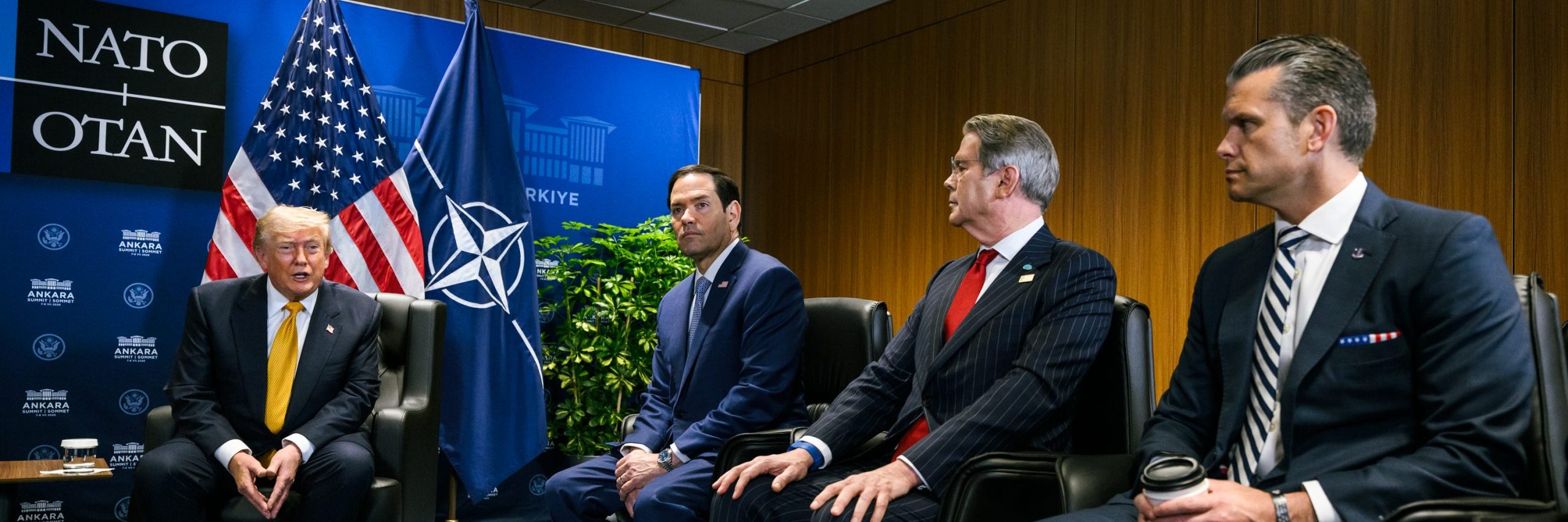
President Trump’s trip to last week’s NATO summit in Ankara has shed no new light on the durability of his administration’s commitment to the bloc or America’s role in European security going forward. Publicly, Trump remains critical of NATO allies’ lack of support for the U.S. war with Iran, disdainful of most European leaders (with a possible exception of NATO Secretary General Mark Rutte and Ukrainian President Volodymyr Zelensky), and openly transactional on a broad range of issues, including allied defense spending, control over Greenland, and military assistance to Ukraine.
Some of Trump’s more radical policy proposals aimed at scaling down U.S. involvement in NATO, such as complete withdrawal from the alliance or a drastic reduction in troop deployments across Europe, would require an act of Congress, where they currently face bipartisan opposition. Instead, Trump has been using national and sectoral tariffs, trade investigations (most recently against Germany over drug pricing), and other coercive trade tools to erode confidence in the predictability of U.S. involvement and accelerate Europe’s shift toward greater defense autonomy.
Domestically, America’s role in NATO is a highly partisan issue if not one likely to drive midterm voting decisions for most people. Eighty-two percent of Democrats believe the U.S. benefits from being a member, while just 38% of Republicans agree, down from 55% at the end of Trump’s first term.
MAGA Republicans are ambivalent, with 63% saying the U.S. should withdraw from the bloc yet 69% still willing to defend an attacked ally and around two-thirds viewing NATO as useful for deterring Russian aggression, securing the Arctic, and strengthening America’s defense industrial base. Three-quarters of MAGA supporters think NATO is obligated to help the U.S. in Iran, while just 36% of all voters concur — a smaller gap in perceptions than on Trump’s foreign policy as a whole, which has backing of 90% of MAGA voters and 38% of voters overall.
Even as support for both the Iran war and Trump’s broader foreign policy declines — net approval of the latter is down 18 points since the start of his second term, and Republicans’ credibility on national security is down roughly 7 points — Democrats in Congress have made no corresponding gains, meaning that dissatisfaction with Trump’s approach has not yet translated into greater confidence in Democrats’ ability to manage foreign policy. The open question is whether the party can fold the unpopular war, and its impact on gasoline prices, inflation, and federal spending, into their broader cost-of-living argument, using foreign policy to reinforce rather than distract from their strongest domestic message.
Eight years ago, Democrats turned Republican efforts to repeal the landmark Obama-era health care law into a top campaign issue, helping them win control of the House in the party’s biggest midterm gain since 1974. This cycle, they are adapting their 2018 playbook to align with an overarching affordability message, using the Trump administration’s cuts to federal health insurance programs — which have already raised costs for many and are set to reduce access for lower-income Americans in the coming years — as an opportunity to reach swing voters in competitive races.
Their approach fits the moment: nearly two-thirds of U.S. adults, 64%, worry about being able to afford health care, the biggest financial concern that retains its top spot despite growing anxiety about gas and transportation costs (at 64%, up from 52% in January). Health care is also the cost voters most want Congress to address (at 28% compared with 15% for the cost of gasoline), and the issue a majority, including 63% of independents, say will have a big impact on the way they vote in the midterms.
Democrats have a clear advantage on health care costs, with 45% of voters trusting them more to manage the issue compared with 28% who trust President Trump and Republicans. There is a general sense that the party is more attuned to health care-related concerns than Republicans in Congress, who are focused on partisan priorities like immigration or foreign conflicts.
Trump’s approach to health care costs is unpopular: just 33% of voters approve, including 25% of independents and 36% of non-MAGA Republicans — indicating a possible opening for Democrats’ cost-based arguments among weak Trump supporters. Republicans do have an edge on their perceived ability to root out fraud and abuse in government health programs — where 34% of voters trust them compared with 24% that trust Democrats — but the administration’s handling of health program fraud still meets with majority disapproval, at 58%.
Both parties are already deploying health care-related messaging in midterm battlegrounds, with Democrats targeting states and districts impacted by the cuts to federal health insurance while Republicans portray those cuts as a way to curb waste and focus on market reforms to lower costs. The result is a midterm fight in which health care is less a replay of 2018 than a test of whether Republican-controlled Washington can be made politically accountable for costs voters already feel and cuts whose effects are still unfolding.
